|
 |
 |
|
|
Soil Carbon
Diamond in the Rough | | | by Mike Amaranthus, Ph.D. |
They say if you apply heat and pressure to coal underground over time you can change it into a diamond, but farmers are trying to develop their own gem beneath the soil surface. Coal is basically a fossilized lump of soil carbon: ancient plant and animal remains that we liberate to release energy. Today, the estimated amount of carbon stored in world soils is about 1,100 to 1,600 petagrams (one petagram is one billion metric tons), more than twice thecarbon in living | |
|
| | | vegetation (560 petagrams) or in the atmosphere (750 petagrams). Unfortunately, however, on agricultural lands, soil carbon has been lost at an alarming rate. Carbon in the soil, in the form of organic matter, stable humus or glomalin, can be a "diamond in the rough" for farmers due to the important role it plays in both the productivity and profitability of the farm. Considering the skyrocketing costs of conventional farm inputs, growers are rapidly learning the most effective ways to get carbon back into the soil in order to maintain | |
|
|
|
| | |
|
| | | productivity . |
| | HOW THE SYSTEM WORKS
Carbon input in soils occurs almost primarily via plant production. Plants convert carbon dioxide into tissue and other compounds through photosynthesis. Much of these compounds are allocated to root systems below the soil surface or to fuel the activities of beneficial soil organisms such as mycorrhizal fungi. As plants, roots and mycorrhizal threads in the soil die, they are decomposed, primarily by soil microorganisms. Through this process some of the carbon is stored in the soil and some is released through respiration back to the atmosphere as carbon dioxide. Examples of stable soil organic materials are called humus and glomalin. These residues can | |
|
|
| | | | Loss of carbon leads to degraded farm soil. |
|
| | | | persist in soils for decades, hundreds or even thousands of years.
The humus and glomalin compounds mentioned above are the dark black content of a healthy soil - black due to the carbon content itself. They are critical for the soil's biological activity, productivity and profitability. This "bankroll" of stored energy is truly a gem when it comes to sustainable agriculture. |
| OUT OF SIGHT, OUT OF MIND Leonardo da Vinci once said, "We know more about the movement of the celestial bodies than the soil underfoot." Soil still remains a great mystery. In today's high-tech society most people keep soil out of mind and out of context - yet what could be more important? All living things originate from the soil and eventually return to it. All great civilizations, including the Egyptians, Greeks, Mayans and Romans, depended upon an adequate supply of fertile soil. These civilizations also declined when soil resources became thin due to erosion and bad management.
Throughout history, the story has repeated itself. Great civilizations have flourished where soils were fertile enough to support high-density human communities, and fallen when soils could no longer sustain the demands put on them. The great early civilizations of Mesopotamia arose because of the richness of their soils and collapsed because of declines in soil quality. Poor land management, organic matter loss and excessive irrigation caused soils to become increasingly degraded, leading to power struggles, migrations, and ultimately the collapse of the Fertile Crescent civilizations. | |
|
| | Carbon Sequestration: Amazing Numbers
The Rodale Institute, researchers at Cornell University and the Agricultural Research Service have collaborated to develop estimates of carbon sequestration in soils by implementing organic farming methods. When we apply these numbers to U.S. agriculture, some compelling insights emerge. The bottom line is that U.S. agricultural lands, compared to other types of lands, provide a tremendous opportunity to store carbon in soils (see table, below).
* U.S. agriculture currently releases 750 million tons of CO2 annually into the atmosphere. Converting all U.S. agricultural lands to organic production would eliminate agriculture's massive emission problem. In addition, switching to organic production would actually result in a net sequestering of 811 million tons of CO2 per year.
* If just 10,000 medium-sized farms in the United States (2 percent of the total farmed area) converted to organic production, they would store so much carbon in the soil that it would be equivalent to taking 1,174,400 cars off the road, or reducing car miles driven by 14.62 billion miles. | |
|
|
| | Ancient Greece suffered a similar fate. The philosopher Plato, writing around 360 B.C., attributed the demise of Greek power to land degradation: "[In earlier days] Attica yielded far more abundant produce. In comparison of what then was, there are remaining only the bones of the wasted body; all the richer | |
|
| | and softer parts of the soil having fallen away, and the mere skeleton of the land being left." Plato's reference to "lighter and softer" was likely referring to organic matter content of the soil.
Many experts also blame the collapse of the great Mayan civilization on soil | |
|
|
|
| | |
|
|
|
| | | | exhaustion and erosion, resulting from agricultural practices and vegetation removal. According to Jared Diamond, a UCLA professor and author of Guns, Germs and Steel and Collapse, 90 percent of the people inhabiting Easter Island in the Pacific died because of deforestation, erosion and soil depletion. In Iceland, farming and human activities caused the majority of the soil to end up in the sea, explains Diamond. "Icelandic society survived only through a drastically lower standard of living," he says.
These lessons of the past unfortunately do not seem to resonate in the modern world. Today, we don't think much about the ground beneath our feet that supports our farms, cities and societies. Yet all of us intrinsically know that good soil is just not dirt. When you dig into rich, fresh earth, you can literally feel the life in it. Fertile, living soil is chocolate brown and falls off your trowel and crumbles into small pieces in your hand. It is light and easy and has an enticing aroma. It is the smell of life itself. The ability to recognize good soil allowed our ancestors to survive and thrive for generations, and it is the carbon content of the soil that identifies this important resource. |
| TAKING IT TO THE BANK
Carbon compounds in soil are an investment that could easily be compared to the workings of a modern day bank. Deposits and withdrawals are made by the natural rhythm of root and mycorrhizal activity, decay and | |
|
| | recycling. This bank has been our central "financial institution," sustaining the human race for millennia, although there have been numerous times in our history, in large geographical areas, where withdrawals have exceeded deposits - resulting in biological bankruptcy.
Carbon compounds in soil enhance plant growth directly through both physiological and nutritional effects. Carbon compounds improve root and mycorrhizal development, uptake of plant nutrients, and serve as a source of nitrogen, phosphorus and sulfur. Indirectly, carbon compounds also affect plant growth through modifications of physical, chemical and biological properties of the soil, including an increase in water-holding capacity, the ability to retain nutrients, and improvement of tilth and aeration through good soil structure.
In the last century, soil carbon has been lost at a staggering rate due to excessive tillage, erosion and the use of chemical fertilizers. In temperate regions, for example, half of the soil organic matter commonly disappears after a few decades of tillage. In tropical soils, such losses can occur in under a decade. |
| CARBON & ORGANIC FARMING
For years, many have argued that organically produced food is safer and more nutritious. Now we are learning that a switch to organic production methods is an expedient and soil-based sink for | |
|
|
|
| | | Farmer Gerald Wiebe inspects his fall organic rye crop. |
| |
|
| | reducing carbon from the atmosphere. Data from the Rodale Institute's long-term comparison of organic and conventional farming methods substantiates that organic practices are much more effective at removing carbon dioxide, a major greenhouse gas, from the atmosphere and fixing it as beneficial organic matter in the soil. Organic practices result in rapid carbon buildup in the soil.
The organic approach to sequestering carbon in soils does not rely on high-tech or space-age solutions. It takes advantage of the symbiotic relationships between plants and beneficial soil organisms such as nitrogen-fixing bacteria and mycorrhizal fungi that have been successful at maintaining the productivity of the land for hundreds of millions of years.
Research is revealing that practices such as reduced tillage, the use of cover crops, biological inoculants and manures can dramatically alter the C storage of agricultural lands. Traditionally rotations of grass, clover, and alfalfa as well as manure and compost were used to replace soil organic matter lost to continuous cultivation. This method still works today. Experiments at Rothamsted in the United Kingdom from 1843 to 1975 showed that areas treated with manure for more than 100 years nearly tripled in soil nitrogen content compared to adding nitrogen as a chemical fertilizer. In the areas where chemical fertilizer was used, nitrogen was either lost in soil runoff or exported with the crop. Additionally, a 15 year, side by side study of corn and soybeans at the Rodale Institute in Pennsylvania, showed no difference in crop yields where legumes and manures were used instead of synthetic fertilizers and pesticides. Organic and conventional cropping systems produced similar profits and the soil carbon content for the organic plots increased three to five times. | |
|
|
|
| | FRESH DATA FROM AN OLD EXPERIMENT
Since 1981, the Rodale Institute Farming Systems Trial (FST) has continuously compared conventional and organic farming in side-by-side trials. This research provides a wealth of information about the ecological and economic benefits of organic farming that includes detailed studies of cultivation, fertilizer, mycorrhizal fungi, weeds, compost, cover crops, water quality and profitability. The study contains convincing evidence that organic farming incorporates significant amounts of carbon into the soil, compared to conventional farming.
The key to this process lies in the handling of soil organic matter. Because soil organic matter is primarily carbon, increased levels of carbon directly correlate with carbon sequestration. While conventional farming practices typically deplete soil organic matter, organic farming builds it through the use of composted animal manures, cover crops, legumes and the activities of symbiotic mycorrhizal fungi and bacteria.
"Good organic farmers see carbon as a resource that improves crop quality, soil productivity and yield rather than carbon as a waste product," says Gerald Wiebe, an organic farmer in Manitoba, Canada. Wiebe sees the value of active management of the biological component in soil to encourage carbon storage in soil. "Some organic farmers tend to use a zero-input approach to organic farming, thinking that sunshine, seed and rain are all they need. This often leads to decreased yields with no improvement in soil conditions. The simple non-use of conventional inputs does not guarantee that soil microbial life, carbon levels and soil structure will be restored. However, when mycorrhizal and bacterial inoculants, compost, compost tea, green manures, legumes, etc., are used in a well managed program, positive soil changes happen relatively quickly."
The FST is a long-term experiment comparing three agricultural management systems: one conventional, one legume-based organic and one manure based organic. The FST's two organic systems have shown an increase of 15-28 percent in soil carbon, while | |
|
| | Organic Material, Organic Matter & Soil Carbon
Many times we think of organic matter as the plant and animal residues we incorporate into the soil. We see a pile of leaves, manure or plant parts and think, "Wow! I'm adding a lot of organic matter to the soil." This soil amendment is actually organic material, not organic matter.
What's the difference between organic material and organic matter? Organic material is anything that was alive and is now in or on the soil. For it to become organic matter, it must be decomposed into humus. Humus is organic material that has been converted by microorganisms to a resistant state of decomposition. Humus is approximately 50 percent carbon and 5 percent nitrogen.
Organic matter is stable in the soil. It has been decomposed until it is resistant to further decomposition. Usually, only about 5 percent of organic matter mineralizes yearly. That rate increases if temperature, oxygen and moisture conditions become favorable for decomposition, which often occurs with soil tillage. It is the stable organic matter that is analyzed in soil tests. Organic material is unstable in the soil, changing form and mass readily as it decomposes. As much as 90 percent of it disappears quickly because of decomposition. | |
|
|
|
| | Organic Matter & Carbon in Our Soils
An acre of soil measured to a depth of one foot weighs approximately 4 million pounds, which means that 1 percent organic matter in the soil would weigh about 40,000 pounds per acre and contain roughly 20,000 pounds of carbon. Since it takes at least 10 pounds of organic material to decompose to 1 pound of organic matter, roughly it takes at least 400,000 pounds (200 tons) of organic material applied or returned to the soil to add 1 percent stable organic matter (40,000 pounds) under favorable conditions.
How much has been lost? Research indicates that organic matter content in the prairie regions of the United States and Canada have declined between 50 and 90 percent since the land was first cultivated. Let?s look at an example. Due to organic matter converting to carbon dioxide, the organic matter in a top foot of soil on a conventionally managed Iowa cornfield has decreased from 10 percent to 5 percent. How much soil carbon has been lost? How much CO2 has been released into the atmosphere? A reduction of 5 percent organic matter equals 50 tons of soil carbon (100,000 pounds) lost to the atmosphere. When oxidized, this 50 tons of carbon is equivalent to over 180 tons of atmospheric carbon dioxide released from a single acre! There are millions of acres of farmland in the United States that have seen at least a 5 percent decline in total soil organic matter content due to conventional farming practices. | |
|
|
|
| | | the conventional system has shown no statistically significant increase. In organic systems, that converts to more than 1,000 pounds of captured C (or about 3,670 pounds of CO2) per acre-foot per year. |
| THE 5-STEP PROGRAM TO RECOVERY
How do we stop burning up our soil organic matter to produce food? How do we conserve and increase soil | |
|
| | organic matter? Following five basic steps can make the difference between storing or releasing carbon in our soils.
1.) Grasses and legumes. The periodic use of grasses, grass legumes or legumes in a crop rotation can add large amounts of organic matter to the soil.
2.) Continuous cover. This method keeps plants pumping soil with carbon year-round and supports the sequestering | |
|
|
|
| | |
|
|
|
| | | Mycorrhizal-inoculated eggplant (left) exhibits increased yield compared to control plots. |
| activities of beneficial soil organisms such as mycorrhizal fungi. The results are soil organic matter at higher levels than fallow-cropping systems.
3.) Conservation tillage. No-till or minimum tillage reduces organic matter decomposition and release of carbon from the surface soil. In the process, it also increases the physical structure of the soil, populations of mycorrhizal fungi and their ability to deposit carbon-rich glomalin in the soil (see below for a fuller discussion of glomalin).
4.) Mycorrhizal inoculation. Mycorrhizal activity has been shown to significantly increase the accumulation of carbon in the soil by depositing glomalin. Glomalin is a compound excreted by mycorrhizal fungi that adds carbon to the soil in vast quantities and improves soil structure.
5.) Manure and compost inputs. Manure and compost additions to the soil provide an organic carbon source; soil organisms over time convert that material to a stable carbon form, humus. |
| THE LINK TO SOIL LIFE
The work of another Rodale research collaborator, Dr. David Douds of the USDA Agricultural Research Service, suggests that healthy mycorrhizal fungi populations in the organic systems help deposit carbon in soil. In the FST, soils farmed with organic systems have | |
|
| | greater populations of mycorrhizal fungi. Over-wintering cover crops supply energy to fuel the activities of mycorrhizal fungi in the organic system, in contrast to the conventional systems, which have a significantly greater fallow period. Reduced chemical use in the organic system also provides an environment more favorable to the spread of the mycorrhizal fungi and the glomalin they release in the soil. Other benefits to the proliferation of the mycorrhizal fungi have been profound. In another three-year study of mycorrhizal fungi at the Rodale Institute, pepper and potato yields increased 34 percent and 50 percent, respectively, compared to controls. Douds' research suggests that a small amount of mycorrhizal fungi can be substituted for a large amount of fertilizer in the growing of crops.
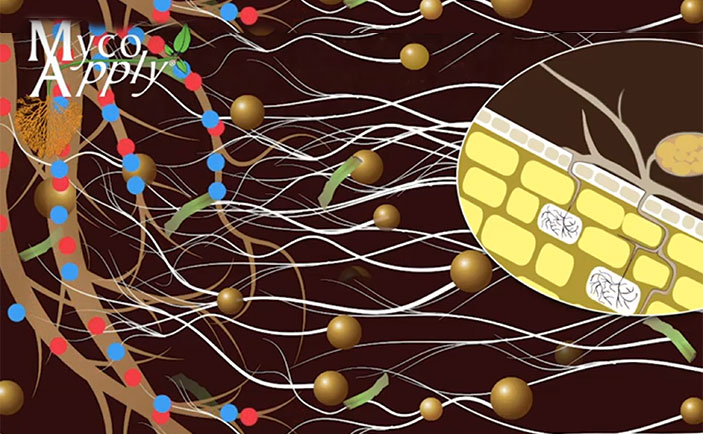
Utilizing the mycorrhizal relationship on the farm has global implications in the strategy to increase the carbon content of soil. Most plants, including more than 90 percent of all agricultural crops, form a root association with these specialized fungi. Mycorrhizae literally means "fungus roots" and is a symbiotic association, between fungus and plant. Fungal filaments extend into the soil and help the plant by gathering water and nutrients | |
|
| | | and transporting these materials back to the roots. In exchange, the plant supplies sugar and other compounds to fuel the activities of the fungus. Miles of fungal filaments can be present in an ounce of healthy soil. The crop's association with mycorrhizal fungi increases the effective surface absorbing area of roots several hundred to several thousand times. This is an example of symbiosis, a win-win association. "I switched from conventional to organic production and used mycorrhizal inoculation to help sustain my yields. What has been interesting is that my fertilizer use has declined dramatically and my yields have stayed constant, yet the nutritional value of my produce is improving." says Bob Dyer, a large-scale fruit grower in Mexico and Texas. |
| CARBON-RICH ORGANIC SUPER GLUE
Mycorrhizal fungi perform another soil carbon investment service that has only recently come to light. The USDA published a report on work by Sara F. Wright and Kristine A. Nichols that suggests that the substance glomalin, discovered by Wright in 1996, is a mechanism for storing large amounts of carbon in soil. Glomalin is produced by the mycorrhizal fungal group Glomus, hence the name Glomalin. An organic glue, the glomalin molecule is | |
|
|
|
| | made up of 30-40 percent carbon and can represent up to an astonishing 30 percent of the carbon in soil.
Glomalin acts to bind organic matter to mineral particles in soil. It also forms soil clumps - aggregates - that improve soil structure and deposit carbon on the surface of soil particles. It is glomalin that gives soil its tilth - a subtle texture that enables experienced farmers to identify rich soil by feeling for the smooth granules as they flow through their fingers. Glomalin is a relatively stable carbon deposit found in soils, lasting from seven to 42 years. Mycorrhizal fungi produce glomalin, apparently to seal themselves and gain enough rigidity to carry materials across the air spaces between soil particles. Wright's discovery of glomalin is causing a complete reexamination of what makes up soil organic matter. It is increasingly being included in studies of carbon storage and soil quality.
In an earlier study, Wright and scientists from the University of California at Riverside and Stanford University showed that higher CO2 levels in the atmosphere stimulate the fungi to produce more glomalin. A three-year study was done on semi-arid shrub land and a six-year study was conducted on grasslands in San Diego County, California, using outdoor chambers with controlled CO2 levels. When CO2 reached 670 parts per million - the level predicted for our atmosphere by the mid to late 21st century - mycorrhizal fungal filaments (hyphae) grew three times as long and produced five times as much glomalin as fungi on plants growing with today's ambient level of 370 ppm. These symbiotic organisms may provide a valuable feedback mechanism to increase soil carbon levels.
"Adding carbon to soils is not just an inert chemical process, rather it is profoundly influenced by the biological activity in the soil," says Jim Trappe, mycorrhizal researcher and professor emeritus at Oregon State University. |
| SQUASHING THE SYMBIOSIS
Unfortunately, many conventional agricultural practices reduce or eliminate mycorrhizal activity in the soil. Certain pesticides, chemical fertilizers, intensive cultivation, fallow, compac- | |
|
| | tion, organic matter loss and erosion all adversely effect beneficial mycorrhizal fungi. An extensive body of laboratory testing indicates that the majority of intensively managed agricultural lands lack adequate populations of mycorrhizal fungi. High levels of chemical fertilizers not only are becoming increasingly more expensive, they can also have a devastating effect on beneficial life in the soil. Chemical fertilizers are basically a salt, and as a result they suck the water out of beneficial bacteria, fungi, and a wide array of other organisms in the soil. Arden Andersen, both a Ph.D. agronomist and practicing medical physician, states, "Conventional agricultural practices with an emphasis on pumping the soil with chemical fertilizers can destroy soil life, which in turn affects the quality and nutritional value of our food."
Research has shown these beneficial soil organisms form the basis of the food web, which conserves and processes nutrient capital in the soil and promotes soil structure. Without this soil food web, a substantial amount of carbon is eroded from surface soil, and nutrients leached from the soil into waterways, where they damage water quality and aquatic life. By destroying large segments of living soils, a large quantity of carbon and nutrient capital is lost, and the farmer is forced to add more fertilizer. The job that should be accomplished by beneficial soil organisms must then be done by the farmer. |
| CONCLUSIONS
For decades after World War II, massive inputs of fossil fuels have allowed us to partially compensate for topsoil erosion, organic matter loss and destruction of beneficial soil organisms and essentially cover up poor soil management practices. But the Green Revolution has turned brown. For three straight decades, acres of productive farmland have declined in the United States and farm input costs are skyrocketing. Taking a fresh look at managing soils has never made more sense.
Many of today's organic farming practices combine methods that increase carbon contents in the soil. Instead of relying on synthetic pesticides and fertilizers, organic farming relies on symbiotic and soil | |
|
| | carbon-building practices such as growing legumes with associated nitrogen- fixing bacteria, cover crops, diversified crop rotations inoculated with mycorrhizal fungi and other beneficial bacteria, and animal manures and compost. "It's time to get going," says Professor Dave Perry. "Organic farming is a tried and true method that puts carbon in the soil and provides an abundance of additional environmental benefits." Unfortunately, in the last 100 years we have seen large soil carbon losses as a result of conventional agricultural practices. Farmers are now appreciating how important symbiotic soil organisms and incorporation of carbon sources into the soil were to the farm and are now rediscovering these approaches as the price of fossil fuels and chemical fertilizers skyrockets. Approaches for investing carbon in soils continue to be refined and improved as we learn to appreciate this diamond in the rough for maintaining a productive and profitable farm.
|
| Mike Amaranthus, Ph.D. is adjunct associate professor at Oregon State University and president of Mycorrhizal Applications, Inc., P.O. Box 1029, Grants Pass, Oregon 97528, phone 541- 476-3985, toll-free 866-476-7800, fax 541-476- 1581, e-mail info@mycorrhizae.com, website
www.mycorrhizae.com. | |
|
|
|
| | |
|
|
|
|