Home owners click here

Adding Insurance to Your Plantings with Mycorrhizae

by Kristi Woods, M.S., Mike Amaranthus, Ph.D. and Shawn Semones, Ph.D.

Insurance, we purchase it for our cars, our houses, and ourselves. What about for the trees and shrubs you install? Many landscape companies currently offer a one year guarantee on the plants they install. Landscapers can do many things to guarantee that landscape installations have the best opportunity to succeed. They can choose healthy stock plants, insure proper planting depth, and choose the ideal location for the plant in the landscape. However, after the landscaper leaves the job site, care of the plant is then left to the property owner and here is when most plants fail. Plants can succumb for a variety of reasons including over or under watering, shock of transplant stress, and lack of proper nutrition. Wouldn't it be great if a landscaper could leave behind something that would help insure against common plant neglect? This is where mycorrhizae play an essential role.

Mycorrhizae are specialized fungi that form mutually beneficial associations with plant roots. They help increase establishment and growth, greatly extend the roots' surface area, and
provide resistance against stress. The presence of mycorrhizae results in healthier plants.

Typically, both the plants and mycorrhizal fungi benefit from their association with each other. This functional give-and-take relationship provides a carbohydrate source for the mycorrhizal fungi, which is what they need to grow and explore the soil resource. The plant, in turn, benefits from improved nutrient and water uptake, carbon acquisition, phytohormone production, salt tolerance and resistance to pathogens. (above: 2 month establishment of landscape using mycorrhizal inoculants at planting)

Mycorrhizae actually alter the relationship between the plant's roots and the soil, increasing the roots' ability to absorb phosphorus and nitrogen, critical nutrients for plant growth and stress physiology.

Mycorrhizae are an integral part of plant physiology and ecology. Mycorrhizae form an association with over 400,000 different plant species, ranging from primitive plants to more evolutionarily advanced species. The nature of the association depends upon the species of plant and fungus involved as well as the environmental conditions. Forming with approximately 95 percent of all land plants, mycorrhizae are found in a variety of ecosystems and plant communities, including wetlands, deserts, deciduous forests, lowland tropical rainforests, high latitudes and prairies. About the only terrestrial setting in which they do not occur are where plants are absent.

While mycorrhizae are classified into seven major groups characterized by key morphological features of the root-fungus association, the two most common groups are ectomycorrhizae (colonize outside) and endomycorrhizae (colonize inside). Ectomycorrhizae colonize outside root cells and can produce a mushroom, puffball or truffle "fruiting body" above or below ground. Ectomycorrhizae form associations with trees such as pines, birch, oak, walnut, willow and beech (Table 1). Ectomycorrhizae create a sheath of hyphae (fungal cells), increasing the root surface and volume around the plant root and making it harder for fungal or bacterial diseases to penetrate the plant. Although ectomycorrhizae only form with 10 percent of the world's plants, these plants, primarily trees, are the basis for some of the world's most important ecosystems and industries, including building and construction, furniture manufacturing, and landscaping.

On the other hand, arbuscular mycorrhizae, or endomycorrhizae, colonize inside root cells. An endomycorrhizal association is traditionally characterized by two structures: vesicles and arbuscules. Vesicles are used for the storage of carbon. Arbuscules are where the nutrient exchange between the fungus and plant actually takes place. Endomycorrhizae form beneficial partnerships with 70 percent of all plant families, including flowering plants, annuals, grasses, and select trees such as maple, magnolia and dogwoods (Table 1). Endomycorrhizae are critical to plants commonly used in landscaping; therefore, the world would be significantly less colorful without them.

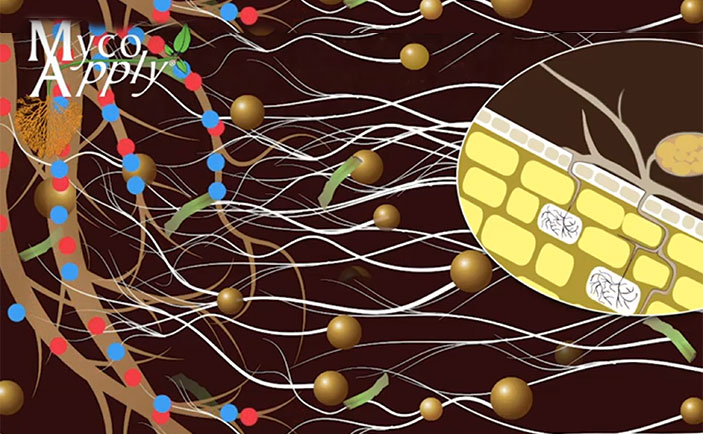
Endo and ectomycorrhizal fungi similarly produce an abundance of tiny threads or "hyphae" (see picture to the right) that spread from the roots themselves into the surrounding soil. These tiny threads are critical for getting plants established by extending the effective absorptive area of the roots system away from the plant and into soil at the planting site.

There are a number of commercially available endo and ecto mycorrhizal inoculants. These inoculants come in various forms, including dry soluble powders, granular pills, tablets and pre-inoculated soil media. Plants can be inoculated via numerous methods such as soil drenching, liquid injections, granular incorporation and vertical mulching. Research has led to the introduction of products with the widest commercial range of mycorrhizal species available.

Applying a mycorrhizal product to established or newly transplanted plants can result in a wide range of benefits to the plant's health, such as increased water uptake, increased resistance to insect pests and diseases, increased nutrient accumulation, and increased transplant survival.


Insurance against under watering
: After the mycorrhizae colonize the roots of a plant, the fungus then grows throughout the surrounding soil and forms an extensive cobweb-like network that explores a larger soil volume than normal roots. These special fungi can increase the ability of the roots to access water in the small areas between soil particles because they are smaller about 1/10 the diameter compared to roots. The ability of mycorrhizae to enter small areas can increase absorption several hundred to several thousand times compared to roots alone.


Insurance against poor nutrition
: Mycorrhizae increase uptake of phosphorus and other tightly bound nutrients to the roots by secreting enzymes in the root zone that unlocks these important minerals. With the enhanced nutrient uptake, mycorrhizae encourage flowers to grow more quickly and efficiently, extending the growing season or providing fruiting trees with earlier yields. An increased growth rate of the root and shoot means plants grow larger, with healthier root zones.

There is also evidence that mycorrhizal roots live longer than plant roots not colonized by mycorrhizae. This increases the total absorbing capacity of the root over its lifetime. Without question, plant health in low nutrient sites is improved by the presence of mycorrhizae. (left tiny absorbent mycorrhizal threads make pools of phosphorus available to the plant)

Insurance against transplant stress: Plants which are colonized by mycorrhizae produce larger, more extensive root systems. This highly developed root system greatly reduces drought stress on the plant since it absorbs moisture more effectively. Inoculated plants also produce new root structures called "feeder roots." The increased surface area provided by the mycorrhizae and their associated threads in inoculated plants increases the ability of plants to become established.

Insuring against some of the main homeowner and business owner miscues by using mycorrhizal products is another method landscapers can use to further their business dollar. If a customer is satisfied with your one year guarantee not only will the landscaper be less likely to have to replace plant stock saving money the customer will spread the word encouraging business to grow.


Table 1. Choosing the proper Mycorrhizae for Your Plant. List of the common trees and shrubs planted in the landscape and the mycorrhizae type they are compatible with. Choose a product based on the tree or shrub being planted and their mycorrhizal status. Most companies offer an all-in-one product containing both ectomycorrhiza and endomycorrhiza to make the decision easy. For a complete list of trees, shrubs and annual plants and their mycorrhizal status please visit Mycorrhizal Applications at www.mycorrhizae.com.


Do my plants need Mycorrhizae?
Find out Here!


Toll Free: 1-866-476-7800


Mycorrhizal Applications | Who We Are | Do I Need Mycorrhizae? | MycoApply® Product Information | Info Articles | Independent Research | Quick Reference - Plants & Fungicides | Mycocyclopedia | Picture Gallery | Movie Gallery | F.A.Q. | Customer Testimonials | Customer Support | Contact Us

© 2004 Mycorrhizal Applications Inc. / All rights reserved